Friday, 6 February 2015

Interview: Aaron Blaise

by  George Upton  I  digiQualia.com 
For over two decades, Aaron Blaise animated and later directed films for Disney such as Beauty and the Beast, Aladdin, The Lion King, Pocahontas, Mulan and Brother Bear, where he specialises in drawing animals. Having left and set up his own animation studio, Blaise now runs his own website and youtube video channel that seeks to democratise teaching on art and animation. 

You have stated you always liked to draw, especially animals. What made you want to get into animation?
I actually fell into animation by chance. I trained as an illustrator at Ringling College of Art and Design from 1986-89. When I started there it was my goal to work for National Geographic as a staff illustrator. When I found out that these positions didn’t exist in the way that I was looking for I started looking elsewhere. I found out that Disney was coming to our school to interview so I put together a portfolio of my work thinking that maybe I would become a background painter. After I was accepted to a Disney internship I became hooked on animation through Glen Keane who was my mentor. It’s because of Glen’s inspiration that I’m an animator today.


Why the interest in animals?
I’ve always felt a bond with the creatures we share our world. For me it’s hard to define why because it’s just always “been” for me. Animals were the first subjects ever depicted through art on cave walls. I think for many of us we can empathize with them. We can feel a bond. 

And what is the process or methods you use to give animated animals expressions and emotions?
I really just feel my own emotions and expressions as I’m drawing a particular animal and attach those expressions to the character. I don’t use a mirror when animating. I never have. I instead end up actually making the expression as I’m drawing it whether on a human or animal. Through this “feeling” I can draw the expression more naturally. 


What was it like working at Disney?
Working for Disney for 21 years was an incredible honour for me. I was creating work that became part of some of the greatest animated films ever made. Working on films like “Beauty and the Beast”, “Aladdin”, and “The Lion King” were highlights of my career. Even more than the work though, we were an incredibly tight family. We all really kind of grew up together. Many of us started in our early twenties and we worked together into our forties. We went to each others weddings, watched each other have children. All while making great animated films. It was like a dream.

What was the best film to work on?
I loved working on Beauty and the Beast. It was my first big break as an animator and Glen Keane, who was supervising the Beast character wanted me as part of the animation unit. He was very generous with the scenes he gave me and it enabled me to shine as an animator. Because of that, I was able to take on bigger rolls and challenges on later films.

I also loved working on Brother Bear as a director. It was the first feature I directed and I learned an incredible amount in creating stories and their structure.


How has the development of technology affected the way you work?
The biggest effect technology has had on the way I work is that when it comes to animation and film development, I rarely work on actual paper anymore. I do almost 100% of my film work on my Cintiq. If I’m animating I use TVPaint on my Cintiq. If I’m doing design or concept work I’m using Photoshop on my Cintiq. Everything is digital now.

What do you think of the future of animation? Will there always be a place for drawn animation over 3D animation?
I don’t think there will ever be a place for 2D over 3D. I think there is a place for both equally though. If we can get the production costs down and create a great story then I think there will be a company in the future willing to take the risk on 2D again.


What are you hoping for with you online educational videos?
I really want to get art education out to a mass audience. I feel that art schools have gotten way too expensive and there might be some talented young people out there that will never be able to go to school because of the cost. That to me is a terrible shame. So, my business partners and myself decided we wanted to start getting art education out to those that may not be able to afford college or maybe they’re in college but are looking for supplemental material. Education should not financially ruin anybody.


Wednesday, 4 February 2015

Interview: Rosaline Shahnavaz

by  George Upton  I  digiQualia.com
Rosaline Shahnavaz is a photographer from South London. Although she only graduated from university last year, she is rapidly making waves across the diverse discipline of contemporary photography - spanning art, fashion and documentary in her work. Her high profile commissions, although a credit to Shahnavaz's seemingly unceasing work ethic, was aided by her outstanding final project, Far Near Distance - an intimate portrait of her cousin's closed life in Tehran juxtaposed with the unattainable beauty of the surrounding countryside and a series of letters that highlight Shahnavaz's relative freedom. For this she won both the Michael Wilson Award and an award from Photoworks.

Having honed her practice in the classrooms and darkrooms of the London College of Communication, Shahnavaz is now making her living as a photographer. I spoke to her about making the step from education to employment, the effect this and on her work and her recent exhibition at the Notting Hill Arts Club in London.

How have you found life post university? 

Post university life has been great. I mean, it has been very non stop. I'm almost too exhausted to be tired.

I've been teaching photography part time, shooting commissioned work, putting on exhibitions, working on personal projects. I guess it's what I've always wanted to do so I'm really embracing it and enjoying every minute of it. It's definitely a good kind of busy. 

Your work during your degree has been very personal, either because it documents those around you or because of the style in which they have been made. How will this be affected by you ever increasing renown and the subsequent commissions, such as that for C-Heads magazine?

Well, I first got into photography through intimate documentation of my friends, or those around me. It's very much the experience of getting to know someone, and the camera almost becomes secondary. I've never been about staging or shooting excessively to find the right shot. It's more about having experiences and capturing it in a photograph. This has translated into all of my work whether I'm backstage at fashion week, shooting a musician for a magazine, or documenting my cousin's poignant story for my degree show. It's always about the people and the relationships I build. That's what's more important to me. Obviously with the shoot such as the one for C-Heads I did have a time limit so it's a faster pace but I still seek to get to know my subjects in all situations. Their personalities need to come through. It's essential to my practice. 


Will you also therefore look towards fashion photography, as you have with TEETH magazine, or stick to a more artistic approach to image making? Or both?

I don't think I need to draw the line between the two. My art has influenced my commercial work a lot. They're not entirely different entities, they definitely influence one another. Doing both is really important to me. 


You were recently featured in a series of articles and a video for Nikon and The Telegraph, how did that come about? 

Yeah that was really fun. They were interested in my work and wanted to follow me shooting some personal work, so they documented me on one of my shoots with the Focus E15 group. It was kind of interesting to look back on a day in my life in a way, I'm often too busy to reflect on what I do so it was nice to sum it up in a few minutes. Although they did make me seem as though I was some sort of Nikon addict and cut out the parts where I discussed my love for my RB67 and my film cameras. I shoot film 95% of the time so I hope the video wasn't too misleading! I think it's revealed in the interview articles that followed it up.

Your recently mounted a solo exhibition, a feat in itself for a recent graduate, entitled Nothing In The World But You. What was the thinking behind the show?

So, Nothing In The World But You was a show of all my personal portraits of my friends that I have taken over the years. They're really almost unintentional photographs. Most of the time I was just a fly on the wall, but it's these photographs that have influenced the way I work with my subjects still today. The opening was really great, my best friend DJed and it was a great opportunity to get everyone together. It was nice, almost reflective. I've been so busy with commercial work so it was nice to kind of take a step back to where it all started. I had a lot of feedback about how intimate the photographs are, how personal they are, and how raw they are. That meant a lot. 


What are you working on/for at the moment? 


I was recently approached by Effra London to shoot their Valentines campaign. They're really into my personal photographs of my boyfriend and myself so they wanted me to more or less recreate these. So I just documented myself and Ben like I usually do but this time wearing some beautiful jewellery! It was such an organic and natural process which is what I love when photographing. I've also got a couple more editorials and some portraits for Topshop and Lula mag coming out soon so keep your eyes peeled! 


Thursday, 8 January 2015

Last Chance to See - Late Turner: Painting Set Free at Tate Britain

by  George Upton  I  digiQualia.com


Much of the otherwise quiet life of Britain’s greatest landscape painter, Joseph Mallord William Turner, is coloured by extraordinary anecdotes. Turner was devoted to art making and it preoccupied the vast majority of his life, but there are only a few, disputed moments that can illustrate the wild, inventive passion evident in his work. In Rain, Steam and Speed - The Great Western Railway (1844), a train rushes obliquely from the turbulent elements, the almost synesthetic effect of which was apparently inspired by Turner sticking his head out of a window of a speeding train. Similarly, Snow Storm - Steam-Boat off a Harbour’s Mouth (1842) allegedly records Turner’s experience of being lashed to the mast of a ship in a storm.

JMW Turner
Rain, Steam, and Speed - The Great Western Railway 1844 
support: 910 x 1218 mm
Oil paint on canvas
The National Gallery, London
Regardless as to the veracity of these stories, the paintings are indisputable - combining a mastery of his medium, oil, with an inventive genius. And perhaps even more remarkable than their mythologies, both works were painted when Turner was well into old age. While the Victorians regarded 60 as the start of a decline into senility, it was the start for Turner of his most remarkable, experimental and significant period in painting. It is this era, from 1835 to his death in 1851, which is celebrated in an exhibition at London’s Tate Britain - Late Turner: Painting Set Free.

The Tate Britain was made custodian of the Turner Bequest, the artist’s gift to the nation of around 30,000 works on paper and 300 paintings, after the artist’s death and it is this that forms the bulk of Late Turner. For visitors used to the extensive collection of Turner’s work that dominates the Clore Gallery of the institution, there are many familiar sights but also the exhibition is successful in bringing together significant works from across the UK and from around the world. 

JMW Turner 
Regulus 1828, reworked 1837 
Oil paint on canvas
support: 895 x 1238 mm frame: 1135 x 1460 x 93 mm
painting
Tate. Accepted by the nation as part of the Turner Bequest 1856 
Indeed, the sheer volume of art in the exhibition effectively conveys Turner’s industry in this period, the artist maintaining his exhibition record for oil painting each year, as well as his development in style and skill. Most interesting in this regard is his Brighton Beach, with the Chain Pier in the Distance, from the West which was originally painted in 1827 but reworked in 1843. This sea scene, in its earliest form, can be seen to owe much to the Dutch seascapes which Turner admired - it is muted, expansive and light. In its reworking, Turner has played onto the matt surface expressive impasto, even using the end of his brush to enliven the surface. It not only reflects his increasing freedom in the medium but his increasing expression and energy in his painting. 

The exhibition is notable for its presentation of Turner’s watercolours. These important and incredibly numerous works, often recording his tours around Europe which he continued to make until six years before his death, are often shown separate, and often as subordinate, to his oils. Here, however, they are given pride of place and rightly are considered not just as beautiful examples of Turner’s painterly practice, as his way of recording natural phenomenon, but as works in themselves. (Painting en plain air in oil did not become widespread until the invention of lead paint tubes in the 1870s). It was in watercolour that Turner first painted and arguably his liquid and translucent use of oil and his command of light, owes much to honing his skills in this watercolour. Venice: The Zitelle, Santa Maria della Salute, the Campanile and San Giorgio Maggiore from the Canale della Grazia (1840) exemplifies this, the colours as vibrant, tone as subtle and the detail as intricate and yet indistinct as his best work on canvas.

Late Turner is a fitting testament to the last years of Turner’s life, but it fails to identify why it was then that he reached the height of his art. His financial security, having found commercial success, meant that he no longer relied so much on commission and could paint with greater independence from his clients. But, more than that, it seems clear from his work, and from his contemporaries who would look with guilt at Turner’s incessant frantic sketching, that painting was Turner’s life. More perhaps than any other artist, it dominated his existence. That he produced his best work towards the end of his life is simply a result of the aggregation of seven decades of concerted, ceaseless work.

JMW Turner 
Ancient Rome; Agrippina Landing with the Ashes of Germanicus exhibited 1839
Oil paint on canvas
 
support: 914 x 1219 mm frame: 1230 x 1530 x 140 mm 
painting 
 Tate.   Accepted by the nation as part of the Turner Bequest 1856
The final room of the exhibition is poignant. The eminent art critic, John Ruskin, believed Turner’s work declined after 1845 and these paintings are certainly the most indistinct and formless. This is largely in part to many being unfinished, an assessment that has only recently been made with these painting erroneously considered proto-abstraction in the 1960s. Welcomingly, the exhibition makes clear that these works would not have been shown by Turner but still they show Turner’s almost pagan love of nature where, as he is reputed to have said on his death-bed, “the sun is God”.


Late Turner: Painting Set Free runs until 25 January at Tate Britain, London

JMW Turner 
Light and Colour (Goethe's Theory) - the Morning after the Deluge - Moses Writing the Book of Genesis exhibited 1843
Oil paint on canvas
support: 787 x 787 mm
painting
Tate. Accepted by the nation as part of the Turner Bequest 1856 

Thursday, 11 December 2014

Interview: Richard T Scott

by  George Upton  I  digiQualia.com


When did you know you would become an artist?

I’ve painted since I can remember. My mother told me that I started intently painting around six.
But it wasn’t until I witnessed a school shooting at the age of 18 that I knew it would be my career. After that, it wasn’t so much that I made a decision, but rather my perspective had shifted and I simply knew.

Where did you train?

After moving to NYC with little more than two dimes to rub together, I studied at the New York Academy of Art. Subsequently, I painted for Jeff Koons for two years and then apprenticed with Odd Nerdrum for three years.

The Sophist

You have stated that you divide your time between the US and Paris? Why Paris?

I moved to Paris because of Odd Nerdrum. He had a summer home there, which he asked me to look after and help manage the other students. While living amongst the decaying grandeur of Nerdrum’s palatial estate, I fell in love with the culture, the food, the people, and so I made connections in Paris and began exhibiting at Galerie L’Oeil du Prince, which is still my primary gallery.

Why painting over other artistic mediums? 

I’ve tried many other media, from writing to photography, installation, printmaking, ceramics to video, but none of them could quite express my thoughts and emotions the way that I desired.
For me painting is a first language. Of course, this has made my path difficult at times - as the market and major institutions reward work that synthesizes forms rather than ventures deeply into one. And though, I have no quarrel with others making art that skims pleasantly across the broad placid surface, I’m more intrigued by the depths of the abyss below.
Though, I realize that this quality separates my work from the contemporary, I don’t see that as a problem.

Hermetica

Why do you paint figuratively? What is it about figurative painting rather than conceptual art that attracts you?

Firstly, I don’t believe that painting figuratively is necessarily non-conceptual. The works of the Old Masters expressed profound and poignant concepts. Further, there are many conceptual artists today who make figurative paintings... though what they do is categorically divergent from what I do. So, I understand what you mean. Conceptual art tends to be cerebral, which I find entertaining, but it also tends to be emotionless. It follows Kant’s principle of aesthetic indifference. On the other side of the coin, some abstract painting may convey some degree of raw emotion, but it doesn’t convey it precisely, nor does it convey narrative, allegory, or depth of meaning. I find intellectual games and experimentation interesting, but ultimately not very meaningful, and neither cathartic nor transformative. For that my work requires both conceptual depth and emotional poignancy.
To make work that speaks both to the mind and the heart requires a language that the viewer can apprehend immediately, intuitively, pre-cognitively. And we humans are wired to respond in the most subtle and powerful ways to other humans.

This is yet another reason I’ve little interest in painting in a Contemporary style as in order to speak in the literary, Post Modern language of Contemporary art, I would have to sacrifice a great deal of emotional potency, aesthetics, and compositional structure in order to set the stage for linguistic inquiry into the context of the piece. The path of distillation/deconstruction traced from Modern to Post Modern thought was a valuable path of analysis, but I feel that I’ve graduated from that school of thought and have embarked on a different path.

Quite a number of painters, composers, and authors I know have found themselves following this path of reconstruction - and finding each other - we’ve realized that we belong to something of a mass exodus from the linear path of Art History. In an attempt to understand what we’ve observed, I’ve been outlining the parameters of our shared philosophy, which lead me to discover the term Post-Contemporary. Coined by Primo Levi in the 1980's, and since forgotten, it seemed to define perfectly, the reconstructive ethos to which we all gravitate.

Just as “Modern Art” is defined by stylistic parameters rather than the actual meaning of the term, “Contemporary Art” holds its own stylistic and philosophical limitations, chief among them is the primacy of the transient “now”, rather than the themes relevant to any human era.


The House by the River Lethe

How does figurative art continue to be relevant today?

Figurative painting and sculpture has always been relevant because we have always been human. And it will continue to be relevant as long as humans live somewhere in the cosmos.

Many of your scenes have a timelessness to them and often feature period interiors or costumes. Is this influenced by the style in which you paint or for another reason? 

We are interesting beings. We walk backwards into the future, peering into the hazy past, for that is all we can see. But those who can see farther, perhaps beyond the horizon, may have a better understanding of what they might stumble upon behind them. In some ways we are like the men in Plato’s allegory of the cave.

This is why my interest lies in expressing human experiences that transcend time, culture, and geography. Even when I paint something that clearly takes place today, my goal is to find the universal... the timeless, the meaning that will transcend our own time and place and retain its meaning for people a thousand years from now. I’m more interested in the light source than the shadows it casts on the wall.

Baptism


Nudity, in one way or another, features heavily for your work (and saw some of your work removed from Facebook). Why? 

The nude is an excellent vessel for conveying meaning without the context of time, culture, or social standing.

Is there one movement that influences you more than another in your work?

The Baroque period is certainly the strongest influence and Romanticism and Symbolism are close to my heart as well. Nevertheless, what I do is not limited to drawing upon the tradition of 20th or the 16th century, but is free to be sincerely and unabashedly influenced by every era. I prefer to have an unconstrained historical palette with which to paint, and I’ve noticed that I’m far from alone in this.


Apart from art, what inspires you? Especially with regard to your compositions.


Much of my work draws upon philosophy, theoretical physics, and literature - particularly magic realists such as Italo Calvino and Jorge Luis Borges. More recently, I’ve been trying to make sense of personal experiences, specifically the school shooting I witnessed as a teenager, which has spawned an interest in the politics of identity, and the history and origins of violence in the American culture. My hope is that somehow my work can be a means of questioning, a path to better understanding, and a means of healing. I believe that even the subtle shift in perspective that the arts can bring to our lives, both as one who creates and one who experiences the creation, like the butterfly effect, does nothing less than influence the path of culture.


Rosemary and Rue

All images are reproduced courtesy of the artist. For more on Richard T Scott see his website here.

Thursday, 4 December 2014

Emilie Pugh 'IN-TRA' at Asylum, London

by  George Upton  I  digiQualia.com


Last night saw the opening of Emilie Pugh’s exhibition, IN-TRA, with collaborator Alice von Maltzahn, who studied with Pugh and shares an interest in drawing) at Asylum London in Peckham, curated by Contemporary Key. This spectacular space, the chapel of London’s largest collection of almshouses, gutted by an incendiary bomb in the Second World War and never restored, was a fitting place to house Pugh’s ethereal works on paper. Candles uplit the degraded frescoed walls and her striking, delicate art. 

Detail of Anatomy of Thought

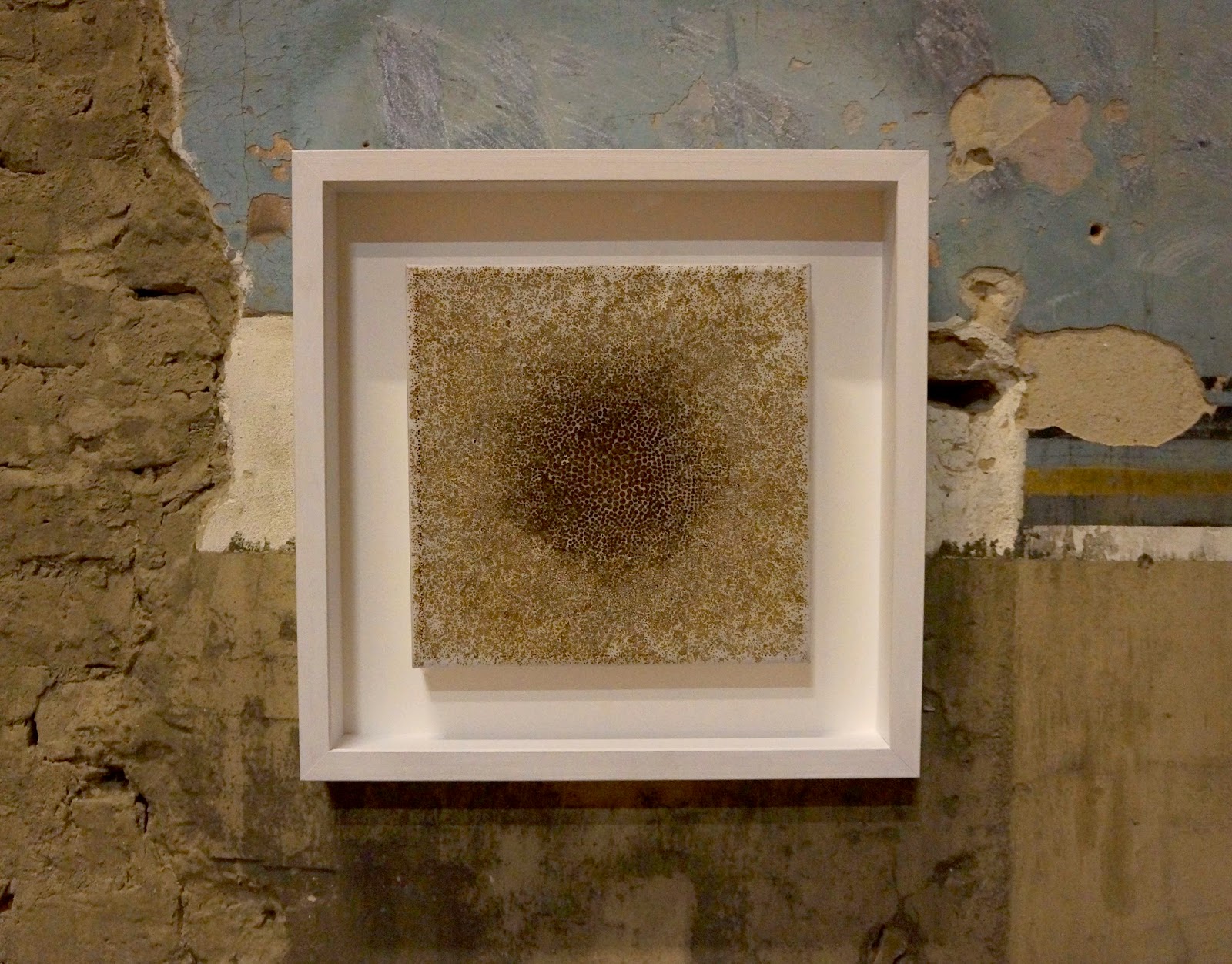
Pugh works slowly and painstakingly to form her images. She never sketches out each piece but instead lets each line and smouldered hole inform the next. Adding incense sticks and gunpowder to the traditional draftsman’s repertoire, she approaches the paper not as simply as surface on which to mark-make but as a medium in itself. 

In past works Pugh has been interested in pushing drawing to its furthest extent, burning the paper to achieve rich, dark blacks, as in the monumental ‘Anatomy of Thought’. Covering a wall in The Courtauld Institute of Art in Gampi paper, Pugh over several months worked it into fantastic billowing lines. The effect is as if an Old Master sketch has been deconstructed and the lines are scattered to the wind, left to form traces of the air; this echo of art history betraying Pugh’s interest in Old Master artwork in addition to her training at The Ruskin School of Fine Art and Drawing at Oxford University.

Cloud Root Diptych

At Asylum, while exhibiting some works by the same methods as before, Pugh has taken a more comprehensive consideration of her medium. Not only working the surface of the paper, she has developed her investigation into the ‘delicate balance between the transitory and the permanent’. Charred holes, sometimes large but often minuscule, delicate, cause the paper to gain a ephemeral state that forms and deforms and glimmers as you move around it. They evoke the trauma caused to the building that houses them and yet the steadied, deliberate act that produced them is not the indiscriminate destruction of explosive. 

Rather, each piece is a process of many hours of careful, repetitive work, reminiscent of Yayoi Kusama’s obsessive Infinity Nets. ‘86400 voids’ is formed of 86400 burnt holes and took the artist 24 hours to make. Pugh believes this meticulous production creates an aura around the work, expressing ‘subtle distortions’ that convey the ‘nuances of human emotions’. 

Perception

The works in the exhibition are all idiosyncratically by Pugh - minimal, paired down and yet expressive and captivating- but the artist approaches this in a different ways. The works on paper, either charred and worked at with pen and pencil, or burnt through, are accompanied with a more sculptural approach to the material. In one work, Pugh has layered the paper that she then burns though to form the an inverse topography that recedes into the frame. In another she has printed onto glass to be projected from a lightbox to great effect. 

In many ways, this exhibition functions as a showcase for Pugh’s continued and continuing exploration into paper and its use as a medium. Sadly, it is only running for two days but check her website for more information and her previous work.

Anatomy of Thought

Installation view of Asylum, London