Wednesday, 30 April 2014

Let’s Talk: Teresa Oaxaca

 
by  Poppy Field  I  digiQualia.com

I can recall the moment I met the artist Teresa Oaxaca with absolute clarity.

It was October 2013.  It was the end of my first week at The Florence Academy of Art. And I had just arrived at my first student soirĂ©e, trying not to look too puffed out from climbing more stairs than I care to remember.

There Teresa stood, with iPad in hand, holding court. Captivated students crowded close by. From a distance I could not see the images of paintings that flew across her screen… rather I wondered if she were some kind of Baroque-born yet Victorian-dressed apparition. For she wore a tailor made gown with a tight corset and full skirt. Her hair was piled atop her head with whispy tendrils running down. 

Teresa Oaxaca with a selection of her paintings.
Teresa is a force. She traces her unmatchable drive back to advice received from the artist Jacob Collins. Quoting Edison, he told her that success is just 10% inspiration and 90% perspiration.

And, art was always her ambition. Having seen a calendar of Michelangelo’s works, Teresa would ‘daydream about [the] Sistine Chapel Frescos' whilst still in Kindergarten. With access to ‘watercolour, drawing materials and sculpey clay’, her childhood was spent ‘drawing, painting and sculpting from imagination’. This was not an academic interest, but her ‘identity’. An identity which many of her friends and classmates were unaware of.

Girl in Pink by Teresa Oaxaca
Teresa’s academic pursuit began when she was just thirteen years old. The Metropolitan Museum of Art was holding an exhibition of Leonardo da Vinci’s works. Teresa came across a selection of his sketches in a newspaper and from that moment, wanted to learn ‘everything’ about the Renaissance and their methods.

So, in 2005, at the age of seventeen, Teresa moved from Washington D.C. to Florence, Italy. She began her traditional training at the Angel Academy of Art and later continued at The Florence Academy of Art. All the while, her weekends were dedicated to the study of anatomy as she committed our internal structures to memory. 

Adam by Teresa Oaxaca
With this unrelenting determination, for which she is well known, Teresa even spent one summer holiday apprenticing with the renowned Odd Nerdrum in Stavern, Norway and upon graduation studied with Robert Liberace at the Art League in Old Town, Alexandria.

Dutch Still Life by by Teresa Oaxaca
Since returning to Washington D.C, Teresa has been developing an unprecedented portfolio. Described by Jeffrey Carlson as ‘nostalgic, colourful and unmistakable for their presence’, Teresa’s consciously elaborate compositions are evidence that a traditional academic training does not pigeonhole an artist to the past.

In fact, Teresa’s artistic voice has become so strong that she is now sought out specifically for her style. She recognises that the very act of commissioning a portrait is a leap of faith and so, once the pose and scale have been agreed, Teresa prefers to take complete control thus ensuring that she remains true to her artistic vision

Born during a Carnivale by Teresa Oaxaca
Everything Teresa owns can be found within her studio and informs her work. Her daily dress, in past historical fashions, was born from the desire to ‘feel at one with [her] artistic inspirations.’ She also collects a range of objects such as antique dolls, skulls and Venetian masks for the ‘art eras or ideas they may represent’ and inspiration they offer.

Plague Mask by by Teresa Oaxaca
 Therefore, each patron’s heirlooms, be it costumes or props, provide new, unexpected inspiration and make for a unique image. Even the sitter ‘occupies a space’ in Teresa’s mind. They will take tea together, Teresa’s current favourites being Orange Pekoe and Pu-erh, so that she may capture more than just a physical likeness.

Although often intimidating at first, Teresa finds that commissions can be incredibly rewarding. However, a word of caution. Teresa’s advice to us less experienced artists undertaking first commissions is to focus on portraits alone – even if you are capable of more.

Cronin Sketch by Teresa Oaxaca
Teresa is particularly drawn to antique dolls for a variety of reasons. From the existence of such figures from the ‘very roots of human civilization’, to their ‘variety of purposes’ and for the range of ‘expectations’ with which they were bestowed.

The Party by Teresa Oaxaca
 And more specifically still, because Teresa’s collection of dolls from the 1800’s have ‘witnessed the 19th century’: a period of art that she holds most dear. This perhaps is most evident in her Jumeau doll from 1879 whose face was modelled by the renowned sculptor Carrier-Belleuse!


Doll Maker by Teresa Oaxaca 
 Yet, the ‘things’ that Teresa truly values are those that are rightly unobtainable such as ‘particular cities and cathedrals, beautiful parks and landscapes.’

Unsurprisingly, travel ‘fuels’ Teresa’s art. During a four month ‘entirely self-guided’ tour of Europe, Teresa was able to study Old Master paintings that she had previously only read about. She also visited as many antique shops and churches as possible; often finding that ‘the sound of an organ coming from within was enough to stop [her] in her tracks’. Adamant that there is always more to learn, Teresa has continued her training by making sketches and reproductions of masterpieces in situ.

God with a Putto by Teresa Oaxaca
On her journey through Europe, Teresa visited London, Brussels, Hamburg, Luneburg, Copenhagen, Eksjo, Stockholm, Mora, Gothenburg, Lund, Malmo, Berlin, Prague, Kutna, Hora, Vienna, Budapest, Switzerland, Florence, Venice, Munich and Amsterdam. After weeks of working furiously in the solitude of her studio, this trip allowed Teresa’s ‘brain to restart’.

In the future Teresa hopes to visit Poland, Southern Germany and Austria in search of Late Medieval Retables as well as spending time in Italy and France. However, if she could visit any museum with any artist it would be the Petit Palais, Paris with Aime Nicholas Morot, 1850-1913, of whom so little is known. There hangs his ‘masterpiece’ The Good Samaritan.  

Since returning from Europe, Teresa has had the confidence to ‘load the palette with more paint and experiment with a great variety of edges and paint textures’. Her work is about ‘pleasing the eye’ and she delights in ‘unusual pairings of subject matter.’ With recurring motifs of cherubim, dolls, clowns, still life and the exploration of portraiture, neo-baroque and chiaroscuro, Teresa’s works are unified by her confident rendering of form, line, gesture and structure. 

Standing Pierrot by Teresa Oaxaca 
 Teresa hopes that one day she will be able to share her knowledge and experiences with generations of younger artists. It is her ambition to build a studio ‘which would double as a home and living quarters for apprentices in the future.’ With well over 6,000 followers on Instagram and more than 3,000 friends on Facebook, finding willing candidates will not be a challenge.

However, Teresa maintains that on the grand scheme of things ‘artists have become marginalized.’ That they are ‘consulted less on important matters like exhibition installations, art acquisitions and curriculum planning.’ That we are witnessing a decline in art being commissioned for the ‘public sphere’ and this is directly related to ‘poor urban planning and the creating of unliveable and unenviable spaces.’


Sleepwalkers by Teresa Oaxaca
 So, Teresa is fighting back. Just last month, she undertook an ‘intense’ live painting demonstration at the Principle Gallery, Alexandria which was also broadcast online. Using the sight-size method, Teresa spent four hours painting before an audience of ‘artists and art appreciators, children, and families, and people walking in off the street’.  Teresa also strives to make her work accessible through social media, posting regular updates detailing her materials, techniques and process in her online Drawing and Painting Journal. It’s certainly inspired me!

If you would like to find out more about Teresa and her work, watch digiQualia’s recent interview by clicking here

Night Scene by Teresa Oaxaca

Thursday, 17 April 2014

Saying hi to Shanghai

 by  Poppy Field  I  digiQualia.com

Can you remember your first significant regret?

I can. The option to study Mandarin had just became available at my secondary school and, to mark the occasion, the newly appointed teacher took to the stage during one morning’s assembly. She delivered a heartfelt plea that we all immediately join her newly launched classes. With the benefit of hindsight, I wish I had signed up there and then!   

For, on 25th March 2014 I found myself representing digiQualia at the inauguration of the Shanghai-Florence Sino-Italian Design Exchange Centre in Florence.

With Shi Yu Liu and Lynn Guo. Photo by digiQualia. 
 The last decade has seen an extraordinary rise in the West’s professional interest in Chinese art. In 2006 Sotheby’s and Christie’s, the world’s biggest auction houses, sold $190 million worth of Asian contemporary art. The majority of this was Chinese. Just two years before, their combined sales of Asian contemporary art had been far less at $22 million.

Last December, the New York Metropolitan Museum of Art unveiled their exhibition Ink Art: Past as Present in Contemporary China. Dubbed as a ‘milestone’ in the history of Chinese contemporary art, it featured work by Ai Weiwei, Fang Lijun, Xu Bing and Zhang Huan.

But the tables have turned. Now, Shanghai has set sights on breaking into the European art Market.

Commissioned to mark the initiative, this table features the white magnolia symbolic of Shanghai and the white lily for Florence. Photo by digiQualia.
This initiative formally began on 10th November 2012 when the Florentine municipal government and UNESCO Creative City (Shanghai) Promotion Office met to sign an official agreement. Its aspiration was for the Villa Stozzi to become the ‘bridgehead for Shanghai and Chinese creative design enterprises’.

Speaking at the event Dario Nardella, the Florentine Mayor, described Shanghai as a ‘metropolis of great change’, full of ‘opportunities and amazing challenges’. He also expressed his belief that, through cooperation with Shanghai, Florence could build a platform of international standards that would encourage the growth of creative professionals.

Florentine Mayor Dario Nardella at the inauguration of the Shanghai-Florence Sino-Italian Design Exchange Centre. Photo by digiQualia.


Currently, Shanghai boasts 48 institutions of Higher Education with their own departments of design, such as the College of Design and Innovation of Tongji University, Fashion Art Design Institute of Donghua University and the Shanghai Institute of Visual Art.

Florentine Mayor Dario Nardella at the inauguration of the Shanghai-Florence Sino-Italian Design Exchange Centre. Photo by digiQualia.


Following the official speeches, I was lucky enough to interview Li Shoubai. As one of Shanghai’s leading artists, Li is considered a master in contemporary heavy colour paintings and paper sculpture.

Spring Comes to Bugao Lane
Born in 1962 to an artistic family, Li created his first artwork when just six years old. It was at the ‘insistence’ of his father rather than of his own desire. But… Li’s interest grew until creating art became ‘all-consuming’ and he chose to make it his career. 

Pingan Lane in Shikumen by Li Shoubai
Li furthered his artistic studies under the painter Lin Ximing and later at the Shanghai Art and Design Academy. Yet, Li cites his greatest influence as ‘places visited’ rather than any one person. His original art is based on Shanghai and follows his motto of ‘innovation originates from self-discovery.’

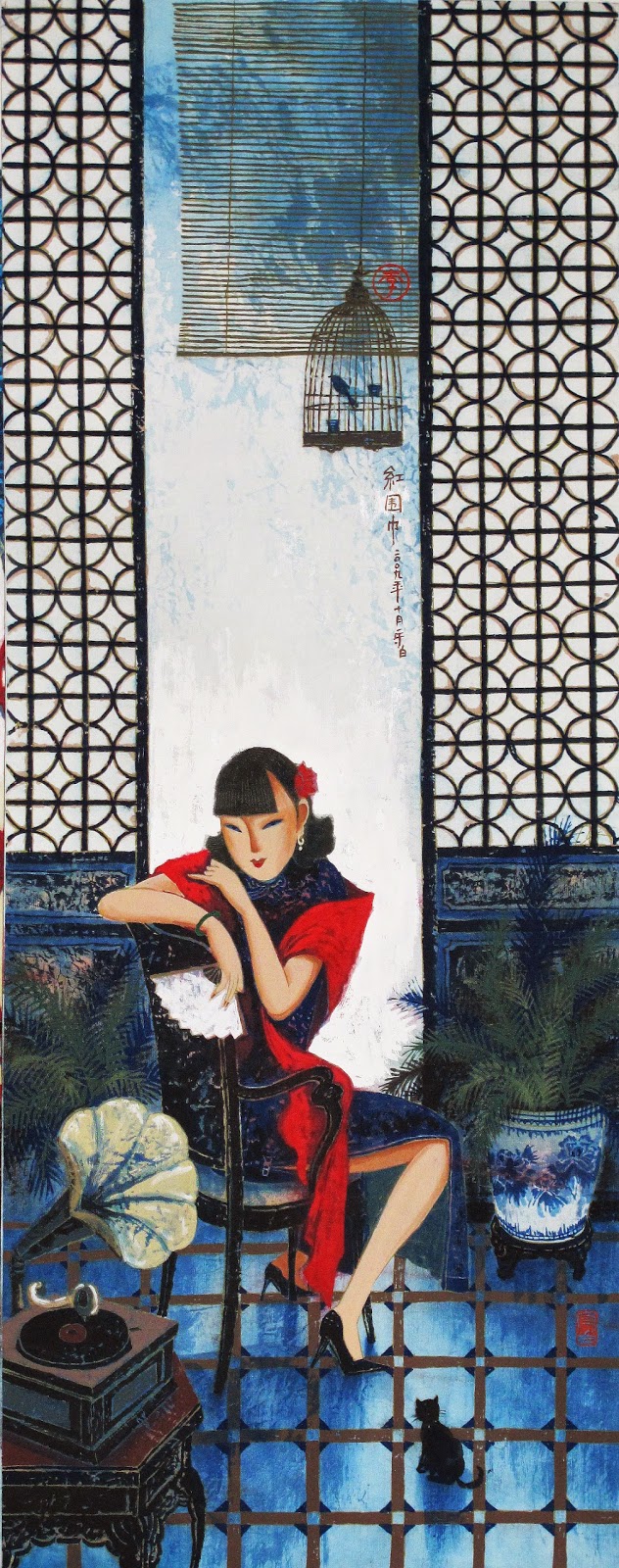
 Red Scarf by Li Shoubai
As such, Li’s art is unique. He strives for his synthesis of heavy colours and feather-like brushstrokes on rice paper to reference both ‘western and eastern elements’.

When I asked if there is a ‘dream image’ that he is yet to capture Li shook his head slowly. Just as I began to worry that I had caused offence, Li spoke. He explained that his projects are all ‘creative processes’… that his achievements are ‘based upon life’. Therefore, Li couldn’t possibly know what an image would look like if he had not yet experienced it.


The Site of the First National Congress of the Communist Party of China by Li Shoubai
Even as it was happening, I knew 25th March 2014 to be a steep learning curve. Although I was able to follow the Italian speeches, having to rely on another when talking with the Shanghai officials and artists was an unsatisfying experience. It certainly made me regret not studying Mandarin! I’m glad my more business-minded younger sister is.

With  Li Shoubai, Mrs Shoubai, Shi Yu Liu and Lynn Guo. Photo by digiQualia. 


Shanghai is one of China’s most powerful economic centres. Predictions state that by 2020 it will be an ‘international centre for finance, trade, shipping and economy.’ If the Shanghai-Florence Sino-Italian Design Exchange Centre is a success – I am certain we can add art to the list!

Sunday, 30 March 2014

From Life or not From Life… that is the question.

 
by  Poppy Field  I  digiQualia.com

Florence is magical. Call me biased, but I would argue that its artistic community is too.

Just last week I was wandering along the Arno when I bumped into my good friend Timothy McGuire. He was putting the finishing touches to a small oil painting following his first day of teaching a plein air course with fellow artist Joseph Altwer.

Timothy McGuire painting the Ponte Santa Trinita
Joe had set himself up on the opposite side of the Ponte Santa Trinita and, with teaching finished for the day, he was all set to develop his own demonstration piece. Well, then I interrupted. Rather than offer a gruff greeting and turn back to his work, Joe handed me a series of brushes and invited me to join in. Poor chap must have assumed I’d trained in painting rather than sculpture! Undeterred, I spent a magical afternoon sabotaging my half of the board whilst chatting with Joe.    

With Joe Altwer, painting the Ponte Santa Trinita


Later that evening, I was delighted to relay this unexpected event as I proudly presented the painting to my friend Amanda Granberg. And that was the end of that.

Or, at least it could have been. Instead, I found myself questioning what motives painters to paint from life. After all, their product is two-dimensional – why not simply refer to a photograph? Luckily, my jaunt to Florence held a professional purpose: to record a series of interviews with artists. Perhaps they could provide answers!

My first interview was with Nelson White. Born in 1932, Nelson is a third generation painter who trained under the esteemed artists Nerina Simi and Pietro Annigoni


 Nelson White for digiQualia


It was therefore unsurprising that, when questioned about painting from life, Nelson’s response held echoes of Simi and Annigoni’s teachings. Simi's father studied under Jean-LĂ©on GĂ©rĂ´me. It was to GĂ©rĂ´me that Nelson referred to when expressing that, potentially, one can paint well from photographs. However, Nelson was also quick to add that GĂ©rĂ´me was experienced in a way that many artists today are not.

Nelson continued on to share his belief that painting from photographs can strip a subject of its emotion. That inevitably, when an artist trained to work from life turns to photography his work will worsen. It seems that this sentiment was shared by Annigoni who spoke of the camera as a barrier. A barrier which would prevent the artist from receiving a direct impression to interpret. 


Bagno La Salute by Nelson White, 2013


However, Maureen Hyde, a principle instructor in the Intensive Drawing Program at The Florence Academy of Art (FAA) pointed out that there are instances when taking photographs is necessary. As I probed further Maureen warned that I was entering dangerous territory. That this is a much debated, ‘big and long topic’. That there is no right or wrong and she could only offer her own understanding. 

With Maureen Hyde for digiQualia
In Maureen’s experience, patrons are not always available to sit for the crucial hours needed to produce a high-quality portrait. It is in these moments that Maureen will take a series of photographs and make some sketches. However, it is to these sketches that she prefers to refer. For, working from life is her ‘ideal, it is when the magic happens.’ Over time Maureen is able to extract enough information to render both depth and profundity. Compared to this, a photograph is no more than a moment of existence to Maureen. 

The Fiddler II by Maureen Hyde, 2010
I also interviewed Robert Bodem, the FAA’s Principle Sculptor Instructor. Although not a painter, Rob certainly has an opinion to share! ‘Those who have too strong views on the matter will do bad work from both.’

La Marionetta by Robert Bodem, 2007
Rob went on to explain that working from both life and from photographs facilitates good results should the artist know how to achieve them. Then, Rob drew a parallel that I had not considered before. When a model is posed in a controlled environment, and an artist records this using sight-size, it is similar to looking at a photograph in the studio. While there may be more to capture when working from life, it does not inevitably mean that the artist is honestly representing life.

So, like Maureen, Rob considers photography as an aid rather than a means to an end. But an aid limited to tell the artist only what he does not already know. 

With Robert Bodem for digiQualia


Rob could not name many professional sculptors who work exclusively from photographs. Although on occasion he has been known to use callipers, Rob prefers to rely on intuition while working from life. Just look at Feline… the languid pose was inspired by the live model stretching out whilst on a break!

Feline by Robert Bodem, 2014
The remaining interviews I conducted are part of an ongoing digiQualia project following four young artists from The Alpine Fellowship. The brainchild of Alan Lawson, this brings together figurative painters and philosophers. Inaugurated last year in the Swiss Alps, last year’s focus was to question ‘the way in which the painter works, and lives, and how the world is revealed’.

The first two of these interviews were a particularly bizarre experience. By chance, it meant questioning my previous flatmate Benjamin Arnold and his girlfriend Jennifer Keltos. Just last year they were helping me find my feet in Florence and I had come back to grill them! 

Benjamin Arnold in his studio for digiQualia


Like Rob, Ben feels uneasy when artists champion ‘fundamental beliefs’. As a young man, with '50 good years of painting ahead', Ben asked why shouldn’t he consider photography his friend? Doing so does not mean turning his back on working from life. It does not mean forgetting all that he has learnt over the last three years at the FAA. Instead, Ben believes that programs such as Photoshop may open up exciting possibilities for representational artists.  

With Jennifer Keltos for digiQualia
Similarly Jen prefers to work from life but reflects that different art suits different techniques. Through the work of her three favourite artists, Andrew Wyeth, Alphonse Mucha and Gustav Klimt, she explained why this is so. Wyeth’s work explores life – so why should he not work from life? She interprets the paintings of Mucha and Klimt as imagined, that is conceived in the mind rather than grounded in reality. Perhaps these artists found photography useful when translating their idea to a tangible image. Perhaps, one day, she may too.

Lavey-Village by Jennifer Keltos, 2013


Though to tell Jamie Coreth to paint from a photograph is to deprive Rudolph of his red nose. When working from life, Jamie is assaulted by a range of visual stimuli that he feels neither words nor a photograph can capture. The changing light and atmospheric conditions, his own feelings and subconscious combine to create an expression based on solely on experience. 

Portrait of Jim Penfold by Jamie Coreth, 2012
When charged with copying a photograph his involvement is lost. Jamie argues that one becomes 'confined to a set of shapes and colours'. He is left with the challenge of making a photograph appear as if it is not what it is. The fun disappears.   

Painting of Lucy by Jamie Coreth, 2014
Last but not least was my interview with Amy Moseley. For Amy, music is of paramount importance. She explained that if one is given only two notes and asked to compose a score, that score has far less possibilities than if one is given a complete scale, or superior still, the full range. Through this metaphor Amy argues that, by painting from a photograph, one’s work can only ever be as good as that photograph, it cannot surpass it.

Amy then recalled the advice of Oscar Wilde - that to observe the subject over a long period of time allows one to see the sitter in all their beauty and ugliness before deciding what to portray. Thus, by painting from life Amy feels that she is able to ‘harness much more life.’

Giovanna by Amy Moseley, 2013
All too soon the interviews were over. So I turned to the camera for one final opinion. Well, to the man behind it. Like the majority of our interviewees, Basilio De San Juan Guerrero trained at the FAA. However, his method of observation is a little less conservative. For the painting below of Teresa Oaxaca they spent the best part of a week together establishing an understanding and rapport. Throughout this process Basilio constantly took photographs – searching for one where Teresa was entirely unguarded. Only then, armed with this and his memory did he begin painting.  

Augury by Basilio De San Juan Guerrero, 2012 
By listening to these artists it has become apparent to me that, as with sculpture, painting from life offers more possibilities than from a photograph. However, art is entirely subjective. There can never be right or wrong, good or bad art. At least not in today’s world where we struggle to even define the term. Beauty is as much in the eye of the beholder as the hand that brandishes the brush.